July 16, 2026 · 5 min read
How Stories Build Empathy: Theory of Mind and the Fiction Effect
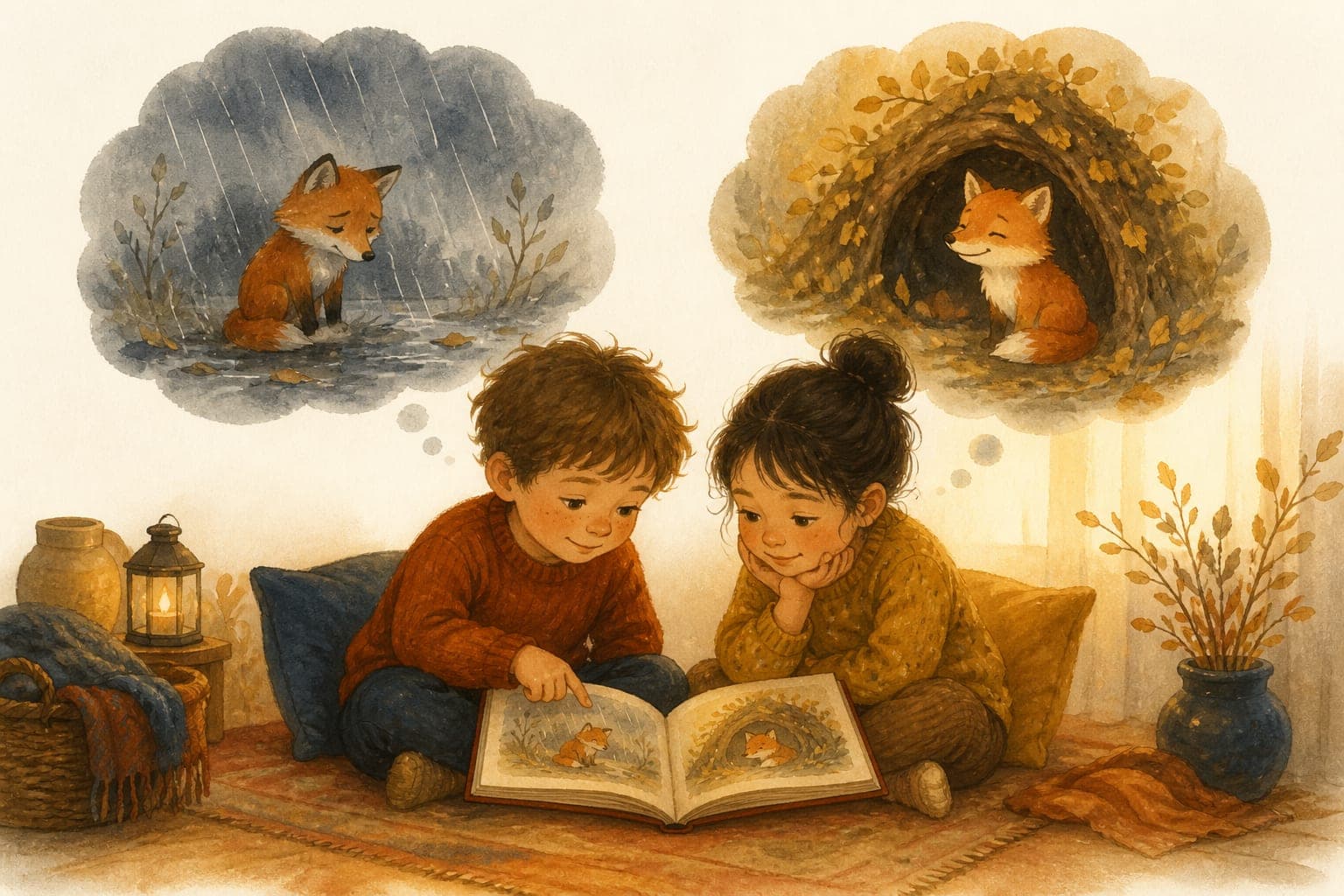
Theory of mind is the understanding that other people have thoughts, feelings, and beliefs different from your own, including beliefs that are wrong. Children develop it in earnest between ages three and five, and it is arguably the single most important social skill a human ever acquires: empathy, cooperation, honesty, and friendship all sit on top of it. And one of the best-documented training grounds for it is remarkably low-tech: being read stories.
This article explains what theory of mind is and how researchers test it, the evidence connecting storybooks to its development, and, because the effect depends on *how* you read, the specific reading habits that turn a story into empathy practice.
The false-belief test: how we know when a child gets it
The classic experiment (Wimmer & Perner, 1983) goes like this: Maxi puts his chocolate in the blue cupboard and goes out to play. While he's gone, his mother moves it to the green cupboard. Where will Maxi look for his chocolate? Three-year-olds confidently answer the green cupboard, they know where the chocolate *is*, and cannot yet represent Maxi's out-of-date belief. By five, most children answer the blue cupboard, sometimes grinning at the trick. That grin is one of the great milestones of human development: the child can now hold a mind that is wrong inside a mind that is right.
The evidence that stories train it
In 2010, Raymond Mar, Jennifer Tackett, and Chris Moore tested preschoolers' theory of mind and measured their media exposure. Children's familiarity with storybooks predicted their theory-of-mind performance, and the relationship held after controlling for age, gender, vocabulary, and parents' income. (Interestingly, television exposure showed no such relationship in their data; watching stories and inhabiting them appear to be different activities.)
Why would stories train mind-reading better than life does? Because stories cheat: they show the hidden layer. Real people's thoughts are invisible; a storybook narrator says *the fox pretended to be asleep because he wanted the hen to come closer*. Intention, deception, false belief, the full machinery of other minds, labeled and slowed down to a preschooler's speed, night after night. Related work in adults (Kidd & Castano, 2013, along with a broader literature on fiction and mentalizing) points the same direction, though the childhood storybook findings are the sturdier foundation for parents.
The active ingredient: mental-state talk
The strongest thread in this research is that it's not the book alone, it's the mental-state talk around it. Parents who naturally narrate inner lives ('He *thinks* the box is empty, but we know better, don't we?') raise children who pass false-belief tests earlier. The story provides the material; the talk does the training. Three habits capture most of the effect:
- Name what characters think and feel, not just what they do. 'She's hiding because she's embarrassed' beats 'she's hiding.'
- Flag the gap between belief and reality whenever the plot offers one. 'He still thinks the puppy ran away! What really happened?' Every dramatic irony in a picture book is a free false-belief lesson.
- Ask perspective questions after the story: 'Why was the sister angry? What did *she* see?', the dialogic-reading move aimed specifically at minds.
When the child is the hero, the practice reverses
There's a useful twist when the story is *about* the child. A personalized story where the hero shares your child's name and situation lets the child do the opposite exercise: instead of reaching into a stranger's mind, they watch their own mind from the outside, seeing 'Maya' feel the jealousy they feel, from one step away. Psychologists call this self-distancing, and it has measurable effects on children's self-control (we cover that research in the Batman Effect). Both directions of practice matter: generic stories stretch a child toward other minds; a personalized story helps them understand their own. This is why the Heirloom Stories interview writes the child's real feelings into the hero, and why our After the Story questions so often start with 'why do you think you felt,'.
Frequently asked questions
At what age do children develop theory of mind?
The core ability, passing false-belief tests, typically emerges between ages 3 and 5, with most children passing by around 5. Precursors like following another person's gaze and understanding desires appear much earlier, and refinement continues well into the school years.
Do stories actually make children more empathetic?
The evidence says storybook exposure is linked to earlier and stronger theory of mind, the cognitive foundation of empathy, with Mar, Tackett & Moore's 2010 preschool study as the key finding. The effect depends on engaged reading with talk about characters' thoughts and feelings, not on the book as an object.
What should I say while reading to build my child's empathy?
Narrate inner lives: name what characters think, feel, want, and mistakenly believe ('he thinks the cookie is still there, but what do we know?'). This 'mental-state talk' is the ingredient researchers consistently find behind earlier theory-of-mind development.
Is TV as good as books for developing theory of mind?
In the study that looked at both, preschoolers' storybook exposure predicted theory of mind and television exposure did not. Shared reading is interactive and paced for conversation, which appears to be where the training happens.