August 6, 2026 · 6 min read
What Stories Can Do at Every Age: A Developmental Guide from 1 to 8
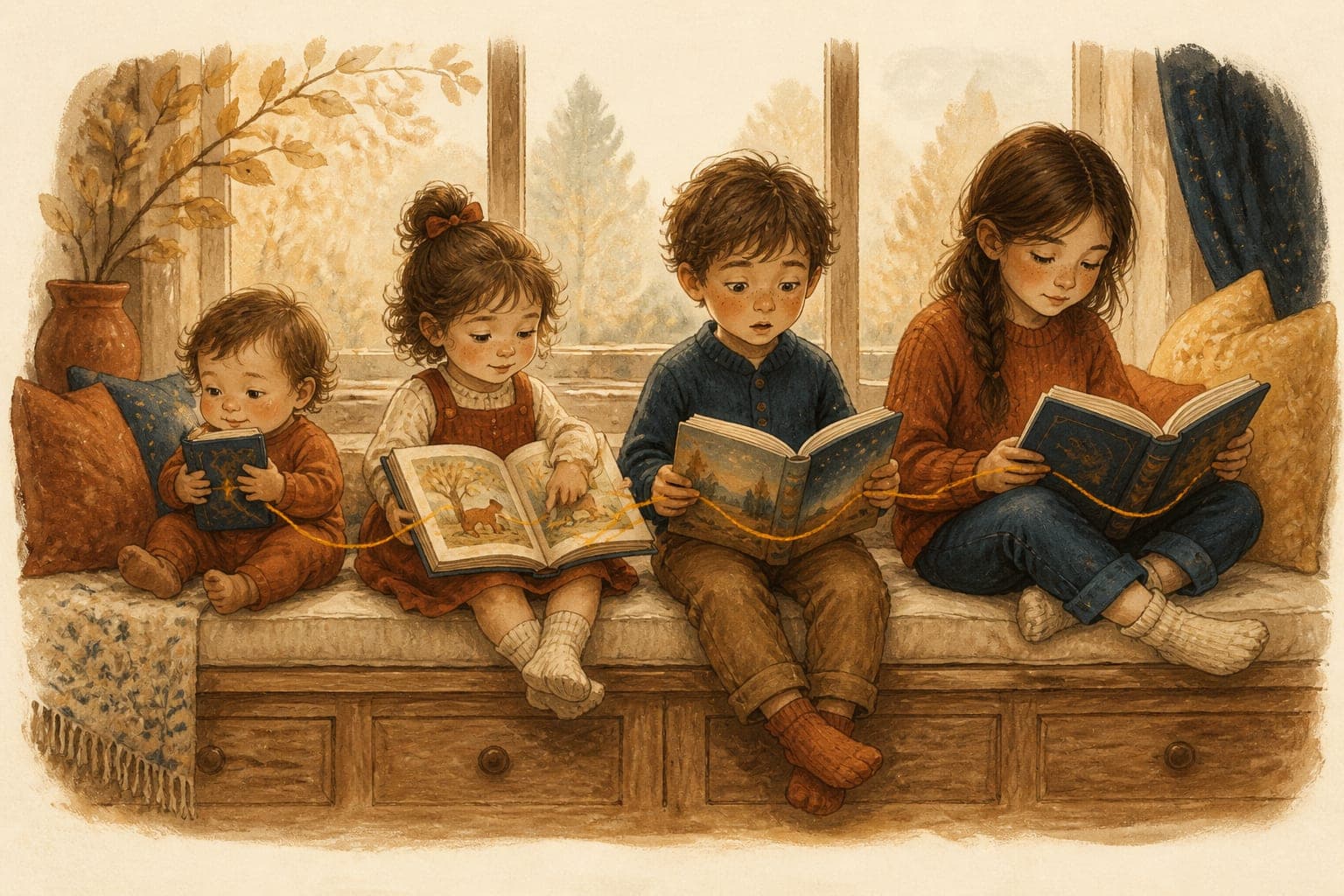
The same story does completely different work in a one-year-old, a four-year-old, and a seven-year-old, because the brain doing the listening is a different machine at each age. A toddler is extracting rhythm and voice; a preschooler is building vocabulary and testing what other minds know; a school-age child is running moral simulations. Choosing a story without knowing which machine you're feeding is how families end up with books that are loved but idle.
This guide maps what developmental science says a child's brain is doing at each stage from roughly 1 to 8, and, the practical half, which outcomes a story can realistically deliver at each age: the thing storytelling can actually accomplish for that child, that month. It's the same age-and-outcome logic our story interview walks through when a family creates a story with us.
Ages 1–2: the voice is the story
A toddler's brain is doing statistical work on language, mapping the sounds, stress patterns, and turn-taking of speech, and doing attachment work on everything else. Plot is irrelevant; a one-year-old cannot follow one. What lands is prosody: the musical contour of a loved voice, the repetition of the same sounds in the same order, the ritual of the lap and the page turn.
- Realistic outcomes: calmer wind-downs, an association between books and safety, early word segmentation, and keeping a distant relative's voice familiar.
- What the story needs: rhyme, repetition, short pages, and above all a voice the child loves, newborns prefer familiar voices from day three, and that preference is the whole engine at this age.
- What to skip: lessons. Nothing didactic survives contact with a fifteen-month-old.
Ages 3–4: the vocabulary engine and the first safe fears
This is the peak of the word-learning years, the stage where the million-word gap is won or lost, and where repeated readings of the same story measurably outperform variety for learning new words. It's also the age where imagination outruns the child's ability to check it, which is why fears arrive now: the dark, dogs, the vacuum, the drain. A three-year-old can't yet reason a fear down, but they can watch a character their size carry it, fiction's safe distance starts working here.
- Realistic outcomes: vocabulary growth, first emotion words, gentler bedtimes, and taking the edge off a specific concrete fear.
- What the story needs: one simple problem, lots of repetition, the child's own world recognizable in it, and a hero who is allowed to be scared before they're brave.
- After the story: point-and-name questions, 'Where's the bear? Is he sad or happy?', the on-ramp to dialogic reading.
Ages 5–6: theory of mind turns stories into rehearsal
Somewhere around four to five, children start reliably passing false-belief tests, the classic demonstration that they now understand other people have minds with different contents than their own. Developmental psychologists call it theory of mind, and it transforms what a story can do. Before it, a character is a moving picture; after it, a character is a *mind the child can inhabit*. This is why ages five and six are the sweet spot for stories that help children through big changes: the child can genuinely rehearse the first day of school inside the hero, not just watch it.
- Realistic outcomes: real rehearsal of upcoming transitions (school, a move, a new sibling), early empathy, notably, preschoolers' storybook exposure predicts theory-of-mind performance (Mar, Tackett & Moore, 2010), and the first 'what would you have done?' conversations.
- What the story needs: an interior life, the hero should think, worry, and change their mind on the page, because minds are what the child is newly able to read.
- After the story: prediction and perspective questions, 'What does she think is in the box? But what do *we* know?'
Ages 7–8: meaning, morality, and the family story
By seven, the machinery is largely built: narrative structure is internalized, attention can hold a longer arc, and children begin tolerating moral complexity, a character can now be *both* unkind and understandable. This is also the age when the family-narrative research bites hardest: children old enough to hold 'Grandpa failed, moved, and started again' are the ones building an intergenerational self from it.
- Realistic outcomes: resilience through family stories, moral reasoning ('was that fair?'), identity ('our family are the kind of people who,'), and stories that dignify harder situations, a diagnosis, a divorce, a death in the family.
- What the story needs: stakes that are real, an ending that's earned rather than tidy, and ideally true material, this is the age to turn real family history into story.
- After the story: open moral questions with no right answer, and the child telling parts back.
The rule underneath the whole guide: outcome first, story second
The common thread across every age band is the direction of choice. Families usually pick a story and hope for an effect; the developmental evidence supports doing the reverse, name the outcome you want this month (a calmer bedtime, a braver first school morning, a child who knows how Grandma got here), check it against what the child's stage can actually use, and then build or choose the story to fit. That inversion is the entire design of the Heirloom Stories interview: it asks who the child is, how old they are, and what the story should *do*, and writes backward from the answer. We've written up the method in full in outcomes-led storytelling.
Frequently asked questions
At what age do children start understanding stories?
Simple cause-and-effect plots start landing around age 2 to 3; before that, children absorb rhythm, repetition, and voice rather than narrative. Full engagement with a character's inner life arrives with theory of mind, around ages 4 to 5.
What kind of story is best for a 3-year-old?
One simple problem, heavy repetition, a recognizable world, and a hero who gets to be scared before being brave. At this age, repeated readings of the same story teach vocabulary better than a rotation of new books, so favorites earning forty rereads is the system working.
When can stories help a child with fears or big changes?
Gently from about age 3, when fiction's safe distance starts working, and most powerfully at ages 5 to 6, once theory of mind lets a child genuinely rehearse a situation inside a character rather than just watching it.
What is outcomes-led storytelling?
Choosing the outcome first, a calmer bedtime, a braver first day of school, a child who knows a family story, and then selecting or creating the story to produce it, matched to the child's developmental stage. It reverses the usual order of picking a story and hoping for an effect.