June 18, 2026 · 5 min read
The Batman Effect: Why Being the Hero of a Story Changes What a Child Can Do
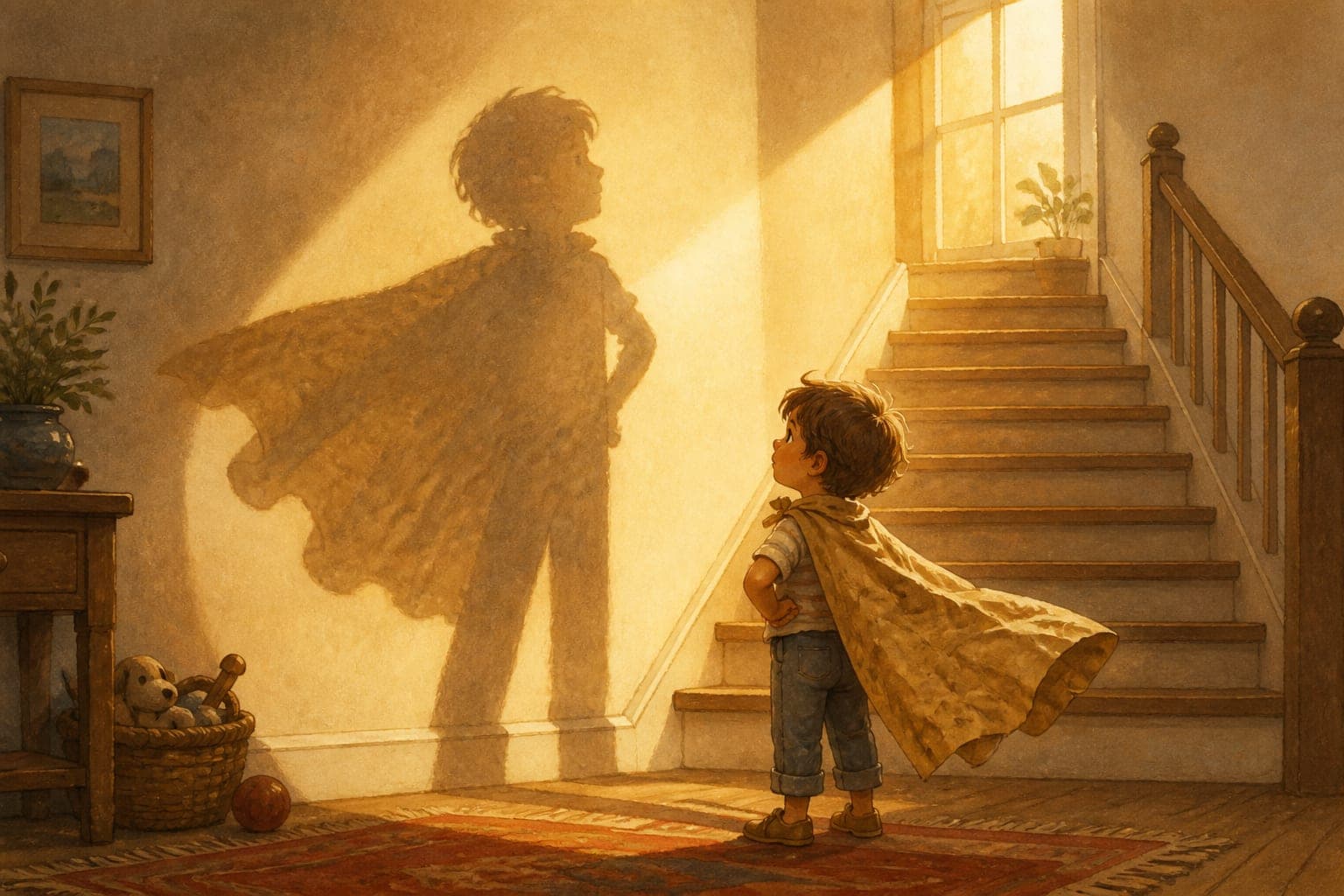
In 2017, developmental psychologists Rachel White, Stephanie Carlson, Angela Duckworth, and colleagues published a study with a finding charming enough to earn a nickname: the Batman Effect. Four- and six-year-olds were given a boring, repetitive task and told to work as long as they could, with a tempting iPad nearby. Some children were prompted to think about themselves ('Am I working hard?'). Some thought of themselves in the third person by name ('Is Hannah working hard?'). And some were asked to *become* a character, given a cape, and asked 'Is Batman working hard?'
The results formed a clean staircase: the further the child stepped outside themselves, the longer they persevered. Batman beat the third-person name, which beat plain self-focus. The mechanism, psychologists call it self-distancing: is one of the most practical findings in child psychology, and it's the deep reason a story where *the child is the hero* is not just a delightful gimmick.
The experiment, in detail
The task was deliberately dull: press a key when you see cheese, don't press for cats, for ten minutes, with breaks allowed and an iPad loaded with fun games sitting right there. The researchers measured how much time children actually spent working. Six-year-olds outlasted four-year-olds, as expected. But within each age, the framing moved the needle: children in the 'Batman' condition (they could also choose Dora the Explorer, Bob the Builder, or Rapunzel) spent meaningfully more time on task than children asked to reflect on themselves in the first person, with third-person self-reference ('Is Hannah working hard?') landing in between.
That ordering is the finding. Each step away from 'me, right now, feeling this', first to your own name, then to a character, bought measurable perseverance. The cape wasn't magic; the distance was.
Why distance helps: the view from one step back
Self-distancing research in adults (notably Ethan Kross's work on third-person self-talk) shows the same pattern: people reason more calmly and regulate emotion better about their own problems when they view them as an observer. Up close, frustration fills the whole frame; from one step back, it's a thing the character is having, not the weather of the universe. For a young child, whose prefrontal regulation machinery is still under construction, the character does some of the regulating *for* them. Becoming Batman outsources composure to someone who has plenty.
There's a second ingredient: borrowed competence. Children in the study weren't just distanced, they were distanced *into someone capable*. A character carries standards ('what would Batman do?') and an implied skill set, and children rise toward the costume. Teachers have exploited this forever, the shy child who can't speak but whose puppet can.
From Batman to 'a story where you are the hero'
Now connect this to personalized stories. A story whose hero shares your child's name, family, and situation is a self-distancing machine with the dials set exactly right: 'story-Maya' is unmistakably *the child*, same name, same new baby brother, same fear of the dark stairwell, but she is also not quite the child: she's one step away, on a page, where things can be watched instead of suffered. The child gets both halves of the Batman Effect at once: the distance (it's happening to story-Maya) and the borrowed competence (story-Maya finds the brave breath and takes the stairs).
This is the psychological engine underneath stories that help children through big changes, and it's why the Heirloom Stories interview asks what the child is facing: the hero is then written to struggle with *that*, visibly, honestly, and to cope in small copyable steps. When the real moment arrives, the child isn't improvising; they're doing what the hero did. Parents tell us the tell-tale sign: mid-challenge, the child mutters the story's line to themselves. That's self-distancing, running exactly as the research describes.
Using the effect at home (with or without us)
- Invoke the character at the moment of difficulty, not after: 'What would story-Maya do first?' works better than a post-mortem.
- Use the child's name in encouragement: 'Sam can do slow shoes', third-person self-talk is the effect's budget version, and it's free.
- Make sure heroes struggle. Choose or create stories where the hero is scared, frustrated, or jealous *first*. Effortless heroes offer distance but nothing to borrow.
- Don't overdraw the account. Self-distancing helps with frustration, fear, and boredom, it is not a lever for skills a child doesn't have yet, and it works best sitting on a foundation of warmth, not pressure.
Frequently asked questions
What is the Batman Effect?
A 2017 finding by White, Carlson, Duckworth and colleagues: 4- and 6-year-olds persevered significantly longer at a boring task when they pretended to be a competent character like Batman than when they thought about themselves in the first person, with third-person self-talk in between. The mechanism is self-distancing, stepping outside your own immediate feelings.
Does the Batman Effect work with characters other than Batman?
Yes, children in the original study could also choose Dora the Explorer, Bob the Builder, or Rapunzel. What matters is a character the child sees as capable, not any specific franchise. A hero based on the child themselves, in a story about their real situation, applies the same mechanism.
How is a personalized story related to the Batman Effect?
A story where the child is the hero manufactures self-distance precisely: the hero is the child (same name, same situation) but one step removed, on a page. The child watches 'story-them' struggle with the real challenge and cope in copyable steps, combining the distance and the borrowed competence that drive the effect.
At what ages does self-distancing work for children?
The original study demonstrated it at ages 4 and 6, with the older children generally persevering more. The underlying capacity for pretend-play and third-person self-reference emerges through the preschool years, so roughly 3 to 4 onward is where character-based framing starts to bite.