July 2, 2026 · 5 min read
Children Who Know Their Family Stories Are More Resilient: The 'Do You Know?' Research
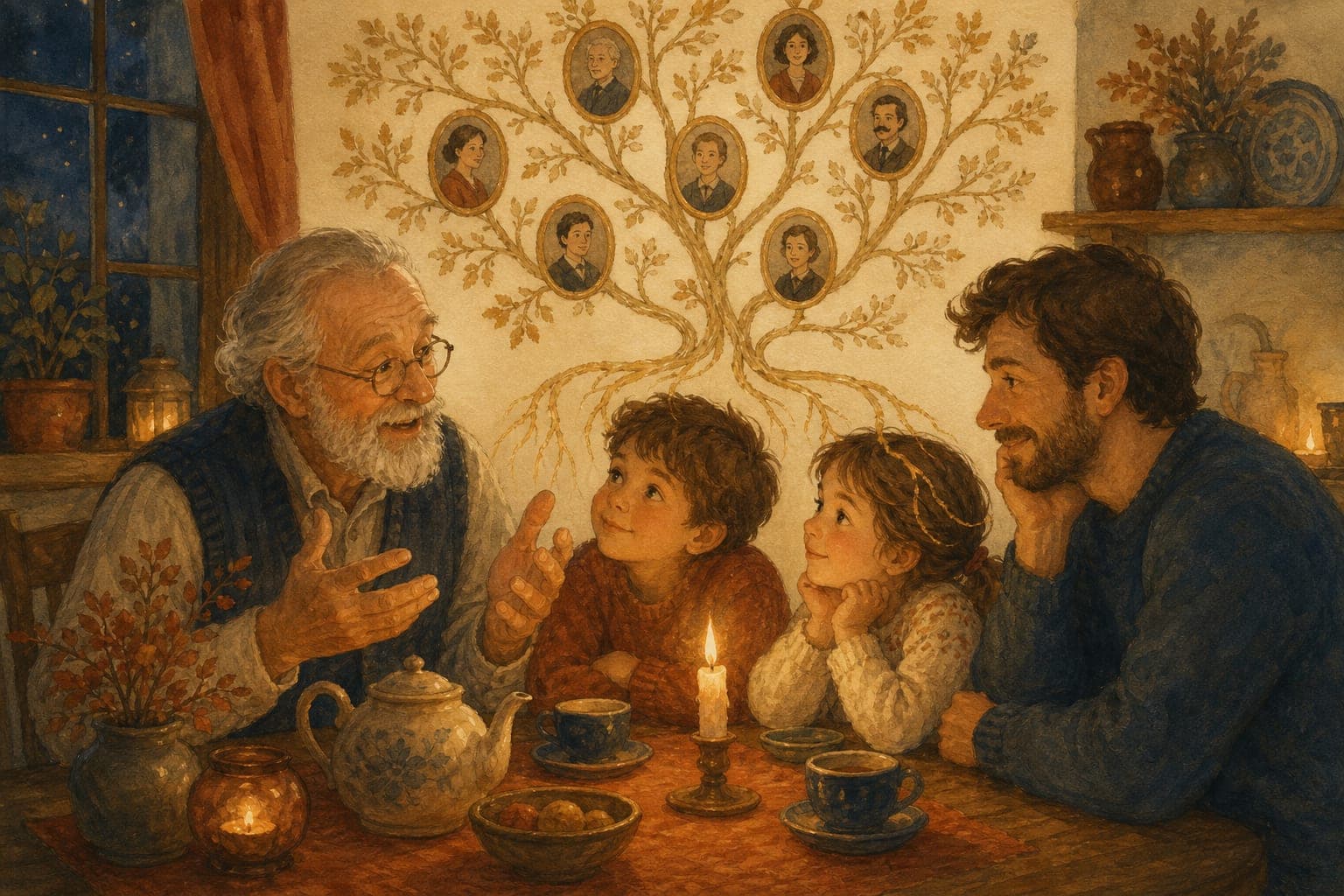
In the early 2000s, psychologists Marshall Duke and Robyn Fivush at Emory University asked a deceptively simple question: does it matter whether a child knows their family's stories? They built a 20-question measure called the 'Do You Know?' scale: Do you know how your parents met? Do you know where your grandparents grew up? Do you know about something hard that happened in your family, and how it turned out? What they found became one of the most-cited results in family psychology: children who knew more of their family history showed higher self-esteem, a stronger internal sense of control, lower anxiety, and fewer behavior problems.
This article explains what the research actually found, the crucial detail most summaries miss, it's not the facts, it's the *telling*, and practical ways to give a child this kind of knowing, including the part grandparents' own voices can play.
What the study measured
The 'Do You Know?' scale asks children twenty factual-sounding questions about their family: how their parents met, where grandparents grew up, family illnesses and triumphs, the story of their own birth. Duke, Fivush, and colleagues, working through the Emory Center for Myth and Ritual in American Life, found that children's scores correlated strongly with independent measures of wellbeing, self-esteem, internal locus of control (the belief that you can affect what happens to you), lower anxiety, and fewer behavior problems. In follow-up work, children with higher scores also showed more resilience in the stressful period after the September 11 attacks.
The finding reached the public through Bruce Feiler's widely shared 2013 New York Times essay, 'The Stories That Bind Us.' But the researchers themselves were careful about what it means, which is where most summaries go wrong.
The real mechanism: not the facts, the telling
Memorizing family trivia does nothing. As Duke has pointed out, a child can't score well on the 'Do You Know?' scale unless something else is true of their family: these stories get told, at dinner tables and bedsides and long car rides, again and again, by people who were there. The scale works as a proxy for a family that narrates itself: one where children regularly hear, ask about, and eventually co-tell the family's stories. That ongoing conversational ritual, not the information, is what builds the strength.
Fivush's broader research program supports this: families who reminisce in an elaborative way, inviting the child into the telling, asking what they remember, dwelling on feelings, raise children with richer autobiographical memory and stronger emotional understanding. It's the same serve-and-return pattern that makes dialogic reading so powerful, applied to the family's own past.
The most protective story has a specific shape
Duke and Fivush describe three shapes a family narrative can take. The ascending narrative: we started with nothing and built everything. The descending narrative: we used to have it all, and we lost it. And the oscillating narrative: our family has had wonderful times and terrible times, the farm failed, the war came, Grandma got sick, and we stuck together and came through. The oscillating shape is the healthiest one, because of what it quietly teaches a child: hard things happen to us, and *we are the kind of people who come through them*. Psychologists call the result an intergenerational self: the felt sense of belonging to something older and larger than you, which turns out to be a buffer against life's blows.
How to build this on purpose
- Tell origin stories at natural moments. Birthdays are for birth stories; holidays are for how-we-met and how-we-got-here stories. Rituals give repetition a home.
- Don't sand off the hard parts. Age-appropriate versions of the failures and losses, always with the came-through-it ending, do more work than the highlight reel.
- Let grandparents do the telling. They hold the deepest stories, and a story told by the person it happened to lands differently. Recording these tellings (we wrote a guide to recording family voices) preserves both the story and the voice.
- Invite the child into the telling. 'And who do you think opened the door? You tell this part.' Co-narration is the goal, that's when the story becomes theirs.
Where Heirloom Stories fits
This research is half of why Heirloom Stories exists. A family story, how Grandpa crossed the ocean, the summer the basement flooded, how your parents met, can be turned into an illustrated story for a child, told in the voice of the person who lived it. That combines the two strongest findings in this literature: the story enters the child's repertoire through warm, repeatable listening (the keepsake link never expires, and children replay what matters to them), and the familiar voice makes the teller present in the telling, across any distance, and beyond it. The After the Story questions then hand the family the co-narration step: 'Ask Grandpa what the boat smelled like.'
Frequently asked questions
What is the 'Do You Know?' scale?
A 20-question measure developed by psychologists Marshall Duke and Robyn Fivush at Emory University, asking children factual questions about their family history, how their parents met, where grandparents grew up, hard times the family faced. Higher scores correlate with higher self-esteem, a stronger sense of control, lower anxiety, and fewer behavior problems.
Does teaching my child family facts make them more resilient?
Not by itself. The researchers are explicit that the scale works as a proxy for families that tell their stories in warm, repeated conversation. It's the ongoing ritual of telling, asking, and co-telling, not the information, that builds the strength.
What kind of family story is best for children to hear?
The 'oscillating' narrative: our family has had good times and hard times, and we stuck together and came through. It outperforms both the all-triumph version and the all-loss version, because it teaches a child that setbacks are survivable and that they belong to people who survive them.
How can grandparents pass down family stories to grandchildren who live far away?
Record the tellings, audio of the grandparent telling the story in their own words and voice, and build them into a ritual the child returns to, like bedtime. Services like Heirloom Stories can turn a family story into an illustrated children's story narrated in the grandparent's own voice, delivered as a private link the family keeps forever.