July 9, 2026 · 5 min read
Your Child's Brain on Stories: What Neuroscience Sees When a Child Listens
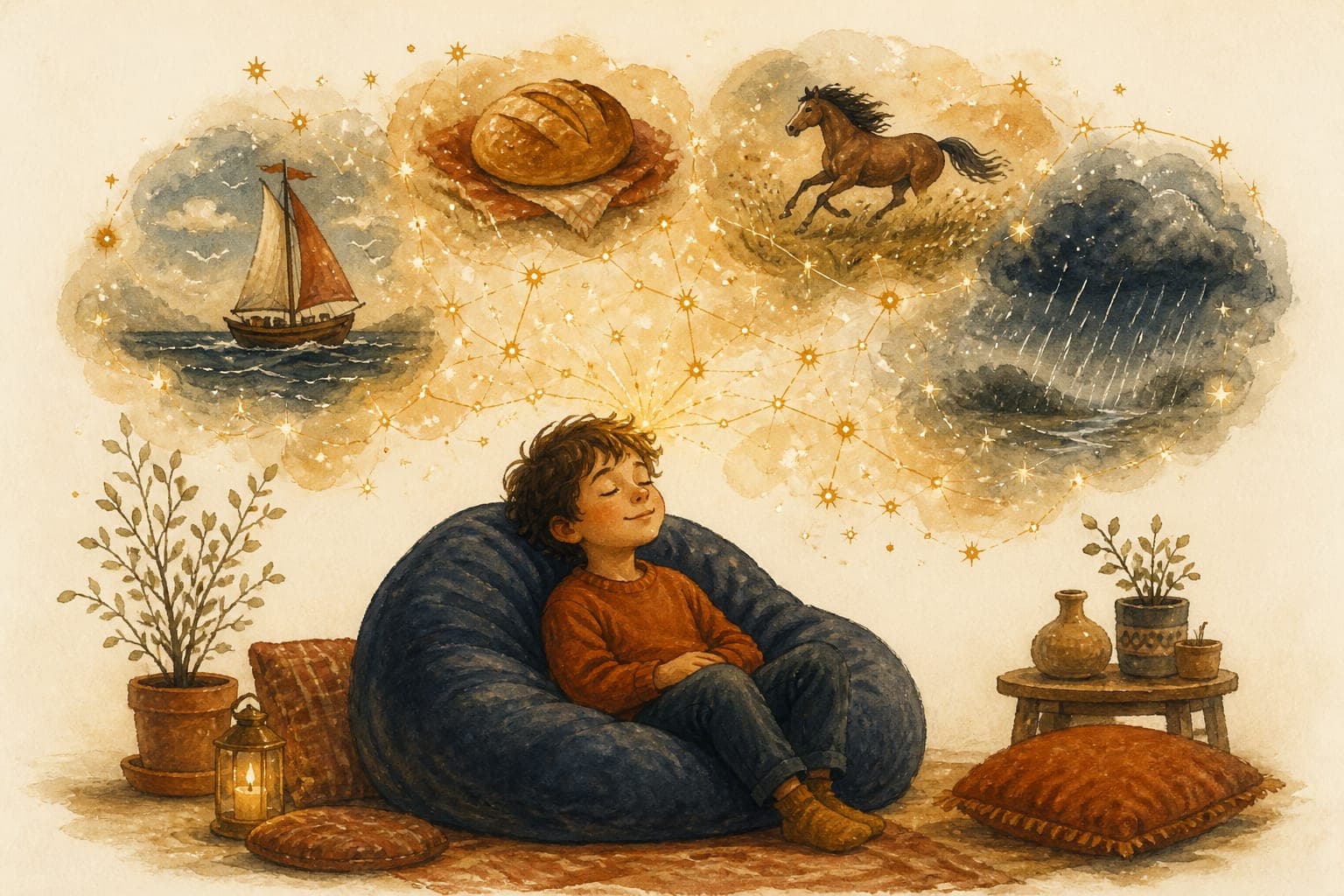
When a child listens to a story, a brain scanner shows something much bigger than language processing. Words for smells stir the smell-processing cortex; action scenes engage motor regions; and the visual imagination areas light up as the child paints the pictures the words describe. Neuroscientists sometimes summarize it this way: the listening brain doesn't decode a story, it simulates one, running the story as a kind of rehearsal of lived experience.
Two other findings complete the picture: a well-told story literally synchronizes the listener's brain activity with the teller's, and children who are read to more show stronger activation in the brain's imagery networks when hearing stories. Here's the research in plain language, and the practical conclusions for anyone telling stories to a child.
Stories run on the machinery of real experience
For decades, language was assumed to live in a couple of specialized brain areas. Imaging studies quietly overturned that. When Spanish speakers read words like *cinnamon* and *garlic*, their olfactory cortex, the smell machinery, activated along with the language areas (González et al., 2006). When people hear texture metaphors like 'she had a rough day,' the parietal cortex that processes physical texture through the skin responds (Lacey, Stilla & Sathian, 2012). Action verbs engage motor planning regions roughly matched to the body part involved.
The implication for children's stories is direct: a story is not information *about* an experience, neurologically, it is a diluted dose of the experience itself. When the hero smells the rain and pushes open the heavy barn door, a listening child's brain rehearses smelling and pushing. This is the mechanistic reason stories work so well as rehearsal for real situations: the brain treats a vividly told first day of school as a small, safe visit to one.
Two brains, one story: neural coupling
In 2010, Greg Stephens, Lauren Silbert, and Uri Hasson at Princeton scanned a speaker telling an unrehearsed story, then scanned listeners hearing the recording. The listeners' brain activity tracked the speaker's, same regions, rising and falling in near-lockstep, with the listener typically a moment behind. Two details stand out. The coupling collapsed when listeners heard a story in a language they didn't understand: it's driven by shared meaning, not sound. And the *stronger* a listener's coupling, including anticipatory activity, where the listener's brain ran slightly ahead of the teller, the better they understood the story.
'Being on the same wavelength' turns out to be a measurement, not a metaphor. For families, it gives scientific shape to something felt at every bedside: storytelling is one of the few activities that literally aligns two minds, which is also a reason the voice doing the telling is not an interchangeable part.
The read-to brain: what practice builds
In 2015, John Hutton and colleagues at Cincinnati Children's Hospital scanned 3-to-5-year-olds while they listened to age-appropriate stories through headphones, and compared the scans against each family's home reading environment. Children from homes with more shared reading showed significantly greater activation in the brain's semantic and visual imagery networks, the machinery that turns heard words into mental pictures, even though they were all just lying still, listening.
The picture-painting machinery, in other words, is trained by use. Every story a child hears without pictures on a screen is a workout for the network that will later carry silent reading, which is largely the art of generating imagery and meaning from bare text. Audio-first stories aren't a lesser format, for the imagination circuitry, they're the heavier weights.
What this changes about telling stories to your child
- Put the senses in. Simulation needs material, the crunch of the gravel, the smell of Grandma's kitchen. Sensory detail is what the brain builds the experience from.
- Let audio be audio. A narrated story with no moving pictures forces the child's brain to render everything itself, that's the Hutton finding working in your favor.
- Repeat the story. Simulation runs deeper on familiar terrain, which dovetails with the repetition research: each replay is a smoother, richer rehearsal.
- Tell it warm and slightly slow. Coupling follows meaning; a rushed telling gives the listening brain less to lock onto.
These four findings are quietly baked into how a Heirloom story is built: written with sensory specifics from the family's own interview, delivered as narrated audio over still illustrations rather than video, in a loved voice, on a keepsake link designed for the fortieth replay.
Frequently asked questions
What happens in a child's brain when they listen to a story?
Far more than language processing: imaging studies show sensory and motor regions activating to match the story's content (smell words engage smell cortex, action engages motor areas), visual imagery networks painting the scenes, and the listener's overall brain activity synchronizing with the storyteller's.
Are audiobooks and narrated stories good for children's brains?
Yes, arguably uniquely good for the imagination network. Because there are no moving pictures, the child's brain must generate all the imagery itself, and Hutton's 2015 imaging work shows that children with more story exposure develop stronger activation in exactly those visual imagery networks.
Is listening to stories better than watching them on a screen?
For the picture-painting machinery, listening does work that watching does not: video delivers the images ready-made, while audio requires the brain to render them. Both can carry a good story, but the imagination workout comes from the audio side.
What is neural coupling in storytelling?
The finding (Stephens, Silbert & Hasson, 2010) that a listener's brain activity mirrors the storyteller's brain activity, region by region, when the story is understood, with stronger coupling predicting better comprehension. It's a literal, measurable version of being 'on the same wavelength.'