June 25, 2026 · 5 min read
Name It to Tame It: How Stories Teach Children to Regulate Big Feelings
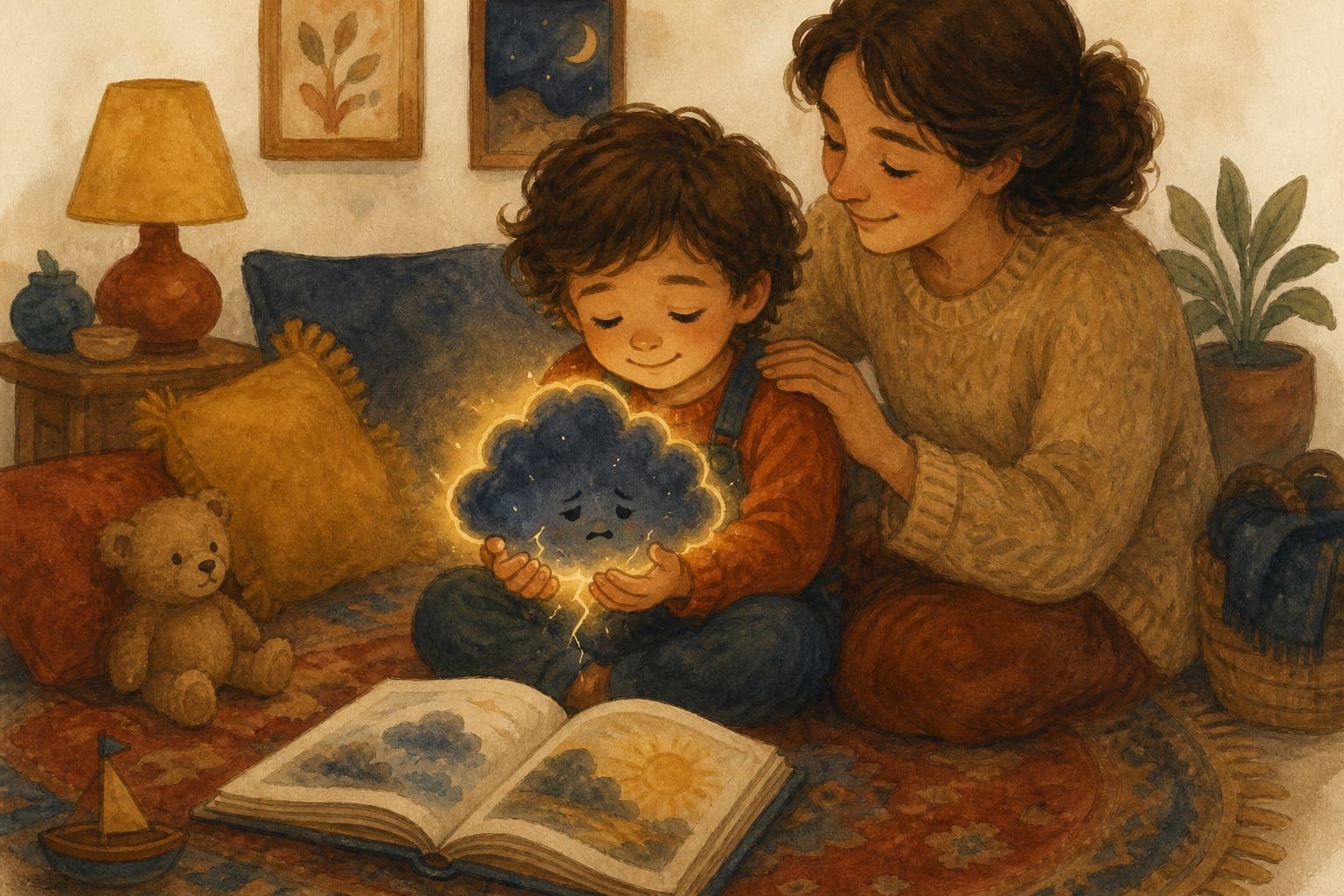
'Name it to tame it', psychiatrist Dan Siegel's phrase, compresses a real neuroscience finding into four words: putting a feeling into words reduces the brain's alarm response to it. In imaging studies, when people labeled an emotion they were looking at, activity dropped in the amygdala (the threat-and-arousal system) and rose in the right ventrolateral prefrontal cortex, a region involved in regulation (Lieberman et al., 2007). Labeling isn't just describing the feeling; it's one of the mechanisms for managing it.
Which creates an obvious problem for a three-year-old: you cannot label what you have no words for. A toddler mid-meltdown isn't choosing not to regulate, they often literally lack the vocabulary the regulation runs on. And the richest, most natural source of that vocabulary is stories. Here's the research chain, link by link, and how to read stories so the regulation actually transfers.
The finding: words calm the alarm system
In Matthew Lieberman's 2007 study, adults in a scanner viewed faces showing strong emotions. When they simply watched, the amygdala responded strongly. When they chose a word for the emotion, *angry*, *scared*, amygdala activity dropped while the right ventrolateral prefrontal cortex, associated with top-down regulation, became more active. The act of labeling appeared to convert a raw alarm into a handled object. Related work has shown the effect operates even when people don't expect labeling to help, it isn't a placebo; it's how the wiring runs.
Developmental psychologists have long observed the same principle from the outside: children with richer emotion vocabularies show better emotion regulation and fewer behavior problems. The word is the handle. No handle, no grip.
Why stories are the vocabulary source
Emotion words are rare in everyday household speech, most of a family's day runs on logistics. Stories invert the ratio. A single picture book can serve a child *jealous*, *disappointed*, *embarrassed*, *proud*, and *relieved* in ten pages, each one attached to a visible situation, a facial expression in the illustration, and a resolution. This is the same mechanism behind the million-word gap, book language is richer than spoken language, applied to the specific dialect of feelings.
Stories also solve the safety problem. Asking a child mid-shame 'are you embarrassed?' pokes the wound. Noticing that *the fox* is embarrassed costs the child nothing, the feeling gets examined at fiction's safe distance, the same mechanism that makes stories work for big changes. The child rehearses the label on the character until the word is worn-in enough to use on themselves.
How to read for regulation
- Name the character's feelings with precision. Reach past *sad* and *mad* for *disappointed*, *left out*, *worried*, *frustrated*. The rarer the word, the more the story is doing.
- Trace the feeling's arc out loud. 'She was furious… then she stomped… then she cried a little… and then it got smaller.' Children need to hear that feelings have middles and ends, not just beginnings.
- Connect gently, once. 'Have you ever felt like that?', and accept no as an answer. The bridge gets crossed on the child's schedule.
- Borrow the story's language during real storms. 'Is this a *Luna-when-the-baby-came* feeling?' A shared story gives the family a private emotional vocabulary that's faster and kinder than an interrogation.
Timing matters: build in calm, use in storm
The vocabulary gets built during calm, connected reading, typically bedtime, and gets *used* during the Tuesday-afternoon meltdown. Expecting a dysregulated child to learn a new emotion word mid-tantrum misreads the neuroscience: the labeling circuit is exactly what's offline. What a parent can do in the storm is lend their own labeling ('you're so frustrated, the tower fell') and reach for story language the child already owns. The nightly story is where that inventory gets stocked, one feeling at a time.
How this shapes a Heirloom story
When a family tells us in the interview that the outcome is emotional, tantrums around the new baby, a fear that spirals, big-feelings bedtimes, the story is written as regulation curriculum in disguise: a hero with the child's name who feels the feeling *with its right name on it*, watches it crest and shrink, and finds one small thing to do with it. The After the Story questions then practice the labels ('what was the feeling in her tummy called?'), and because the keepsake is built for replay, the vocabulary gets rehearsed nightly in a voice that itself calms the child's stress system. Name it to tame it, delivered as a bedtime ritual.
Frequently asked questions
What does 'name it to tame it' mean?
Dan Siegel's shorthand for affect labeling: putting a feeling into words engages prefrontal regulation circuitry and dampens the amygdala's alarm response, making the feeling more manageable. In children it depends on having emotion vocabulary, you can't name what you have no words for.
At what age can children start naming their feelings?
Basic labels (happy, sad, mad, scared) typically emerge between 2 and 3; richer distinctions like disappointed, embarrassed, and jealous develop through the preschool and early school years, largely on the vocabulary children are given. Stories are one of the densest natural sources of that vocabulary.
Why do stories help children with big emotions better than talking directly?
Distance. Naming a character's feeling is safe, it's about the fox, not the child, so the feeling can be examined without defensiveness. With repetition, the labels rehearsed on characters transfer to the child's own inner life, and the story's language becomes a gentle shared shorthand the family can use in real moments.
Should I try to teach emotion words during a tantrum?
No, the regulation circuitry that learning depends on is exactly what's offline mid-tantrum. Build the vocabulary during calm, connected story time, lend your own calm labeling during the storm ('you're so frustrated'), and reach for story words the child already knows.